" height="24.05243258989812px" id="HhB4UN5Ev" width="56.657568182366504px"/></svg>)
" height="17.746942985833318px" id="NcyGeeZaL" transform="translate(6.842 0)" width="17.882429231237495px"/><path d="M 5.691 3.346 C 5.691 2.16 5.972 1.116 6.535 0.14 L 6.394 0 L 1.617 4.741 C 0.562 5.717 0 7.111 0 8.506 L 0 23.148 L 14.754 23.148 C 16.159 23.148 17.565 22.59 18.548 21.544 L 23.325 16.804 L 23.186 16.664 C 22.203 17.225 21.087 17.513 19.954 17.5 L 5.691 17.5 L 5.691 3.347 Z" fill="rgb(4, 20, 89)" height="23.14814814814815px" id="e9Qn7lKgr" transform="translate(0 1.852)" width="23.324907692918487px"/><path d="M 25.013 20.833 L 33.529 0 L 35.838 0 L 44.322 20.833 L 40.226 20.833 L 38.244 15.859 L 30.929 15.859 L 28.945 20.833 Z M 10.404 3.617 L 10.404 20.832 L 6.307 20.832 L 6.307 3.617 L 0 3.617 L 0 0.225 L 16.709 0.225 L 16.709 3.617 Z M 22.748 0.225 L 22.748 20.832 L 18.651 20.832 L 18.651 0.225 Z M 32.07 12.662 L 37.077 12.662 L 35.353 8.236 C 35.08 7.501 34.831 6.758 34.607 6.007 L 34.541 6.007 C 34.367 6.698 34.092 7.438 33.871 8.025 L 33.793 8.236 Z M 44.835 20.833 L 53.352 0 L 55.66 0 L 64.144 20.833 L 60.049 20.833 L 58.066 15.859 L 50.751 15.859 L 48.768 20.833 Z M 51.89 12.662 L 51.89 12.66 L 51.89 12.66 Z M 56.895 12.66 L 55.172 8.237 C 54.899 7.502 54.65 6.758 54.426 6.007 L 54.36 6.007 C 54.186 6.698 53.91 7.438 53.691 8.025 L 53.612 8.236 L 51.89 12.66 Z" fill="rgb(4, 20, 89)" height="20.833333333333336px" id="cu89bllT7" transform="translate(29.856 3.704)" width="64.1441181530643px"/></g></svg>)
Transition
Planner
Transition
Planner
Role & Responsibility
Role & Responsibility
PRODUCT DESIGN
PRODUCT DESIGN
Product direction, hands-on contribution & team management
Product direction, hands-on contribution & team management
CROSS-COLLABORATION
CROSS-COLLABORATION
Stakeholder & collaborator communication, content/product/research collaboration, design system contribution
Stakeholder & collaborator communication, content/product/research collaboration, design system contribution
PRODUCT STRATEGY
PRODUCT STRATEGY
Strategy roadmap & design effort pipeline
Strategy roadmap & design effort pipeline
Collaborators
Collaborators
2 Product Design team · Product · Design System · Content Strategy · Research · Engineering · Business · Accessibility · Legal
2 Product Design team · Product · Design System · Content Strategy · Research · Engineering · Business · Accessibility · Legal
Project Duration
Project Duration
8 months
8 months
As a Staff Product Designer, I challenged an agency-built prototype, reset the direction with leadership's backing, and delivered TIAA's first data visualization patterns inside a new retirement planning tool. In its first three months it helped drive $100M in total asset impact.
It was also featured internally as a strong example of user-centered design and selected as an early candidate for AI integration as part of the "TIAA Next" initiative.
As a Staff Product Designer, I challenged an agency-built prototype, reset the direction with leadership's backing, and delivered TIAA's first data visualization patterns inside a new retirement planning tool. In its first three months it helped drive $100M in total asset impact.
It was also featured internally as a strong example of user-centered design and selected as an early candidate for AI integration as part of the "TIAA Next" initiative.
Outcome
Outcome
50%
50%
Increase in account linking
Increase in account linking
$60M
$60M
Reallocation to TIAA’s products
Reallocation to TIAA’s products
$40M
$40M
Retained earnings
Retained earnings
The situation
The situation
TIAA is a Fortune 100 financial services firm and a leading retirement provider, with more than a century in the market and over $1.3T in assets under management. Facing pressure from digital-first competitors, the company launched a large effort to modernize its legacy platform, and I joined that work as a Staff Product Designer.
Leadership asked me to evaluate an existing proof-of-concept built by a third-party agency and evolve it into an MVP for a transition planner, a tool that shows users how their current income, savings, and investments translate into retirement income.
After a design audit, it was clear the prototype no longer matched current user expectations or product direction. I made the case for a reset, and de-risked it before taking it up. I validated the concerns with research through a targeted survey and confirmed with engineering that the reset would not add delivery risk, then presented the revised strategy to leadership and secured alignment to move forward.
TIAA is a Fortune 100 financial services firm and a leading retirement provider, with more than a century in the market and over $1.3T in assets under management. Facing pressure from digital-first competitors, the company launched a large effort to modernize its legacy platform, and I joined that work as a Staff Product Designer.
Leadership asked me to evaluate an existing proof-of-concept built by a third-party agency and evolve it into an MVP for a transition planner, a tool that shows users how their current income, savings, and investments translate into retirement income.
After a design audit, it was clear the prototype no longer matched current user expectations or product direction. I made the case for a reset, and de-risked it before taking it up. I validated the concerns with research through a targeted survey and confirmed with engineering that the reset would not add delivery risk, then presented the revised strategy to leadership and secured alignment to move forward.
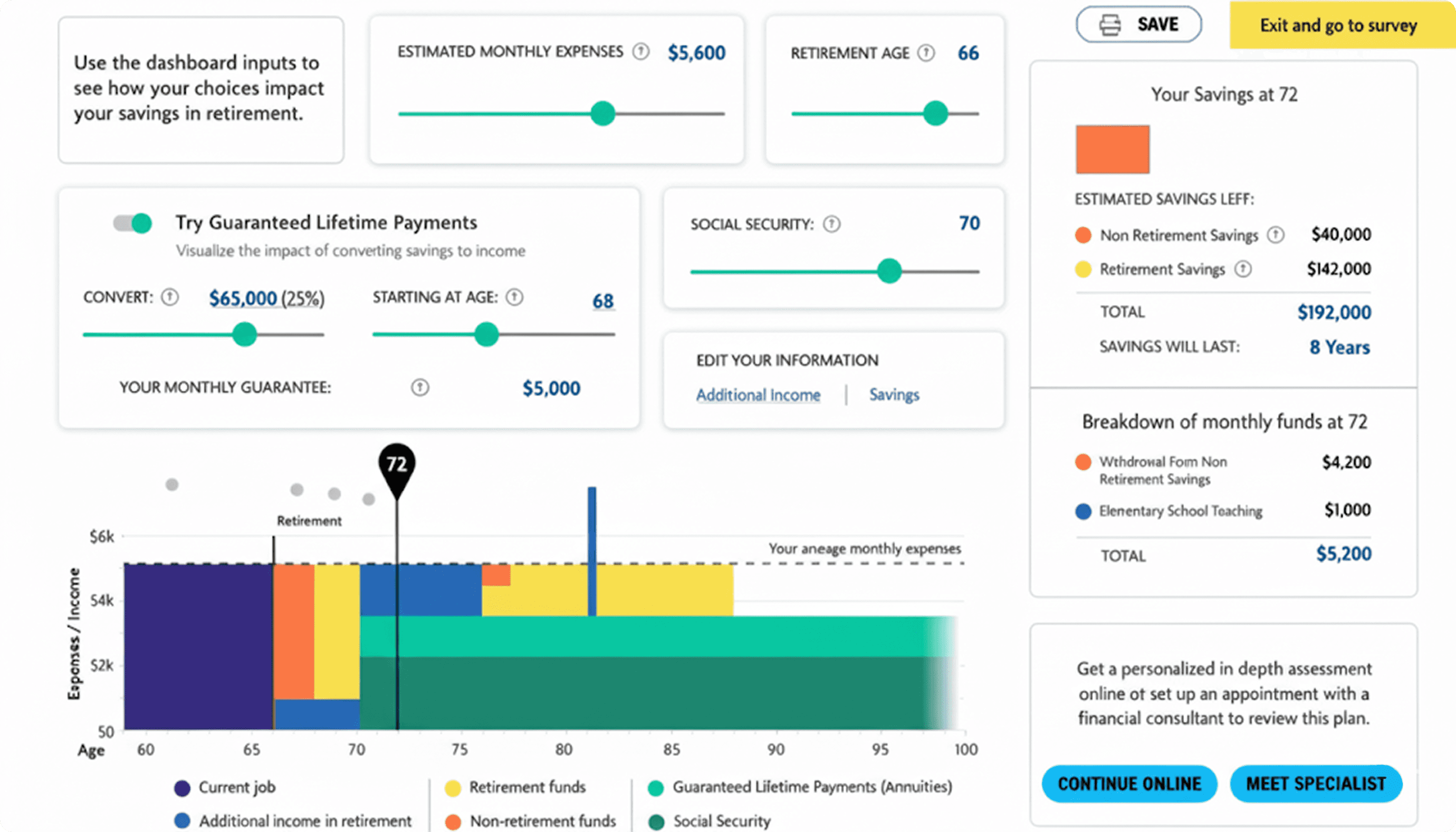
Screenshot of the POC prototype.
Screenshot of the POC prototype.
The problem, in the users' words
The problem, in the users' words
Working with product management on a delivery approach, I ran foundational research, interviewing both TIAA clients and financial advisors. Three issues showed up consistently across leading competitors:
Charts felt intimidating. 68% of participants said they were unlikely to rely on charts to make confident decisions.
Charts lacked expected features. Limited interactivity and unclear affordances reduced engagement.
Tools missed the real question. Users kept asking "Do I have enough?", yet 78% felt existing tools gave no clear answer.
That set the question for the team: how might we reduce cognitive load in retirement planning so users can understand complex financial information and decide with confidence?
Working with product management on a delivery approach, I ran foundational research, interviewing both TIAA clients and financial advisors. Three issues showed up consistently across leading competitors:
Charts felt intimidating. 68% of participants said they were unlikely to rely on charts to make confident decisions.
Charts lacked expected features. Limited interactivity and unclear affordances reduced engagement.
Tools missed the real question. Users kept asking "Do I have enough?", yet 78% felt existing tools gave no clear answer.
That set the question for the team: how might we reduce cognitive load in retirement planning so users can understand complex financial information and decide with confidence?
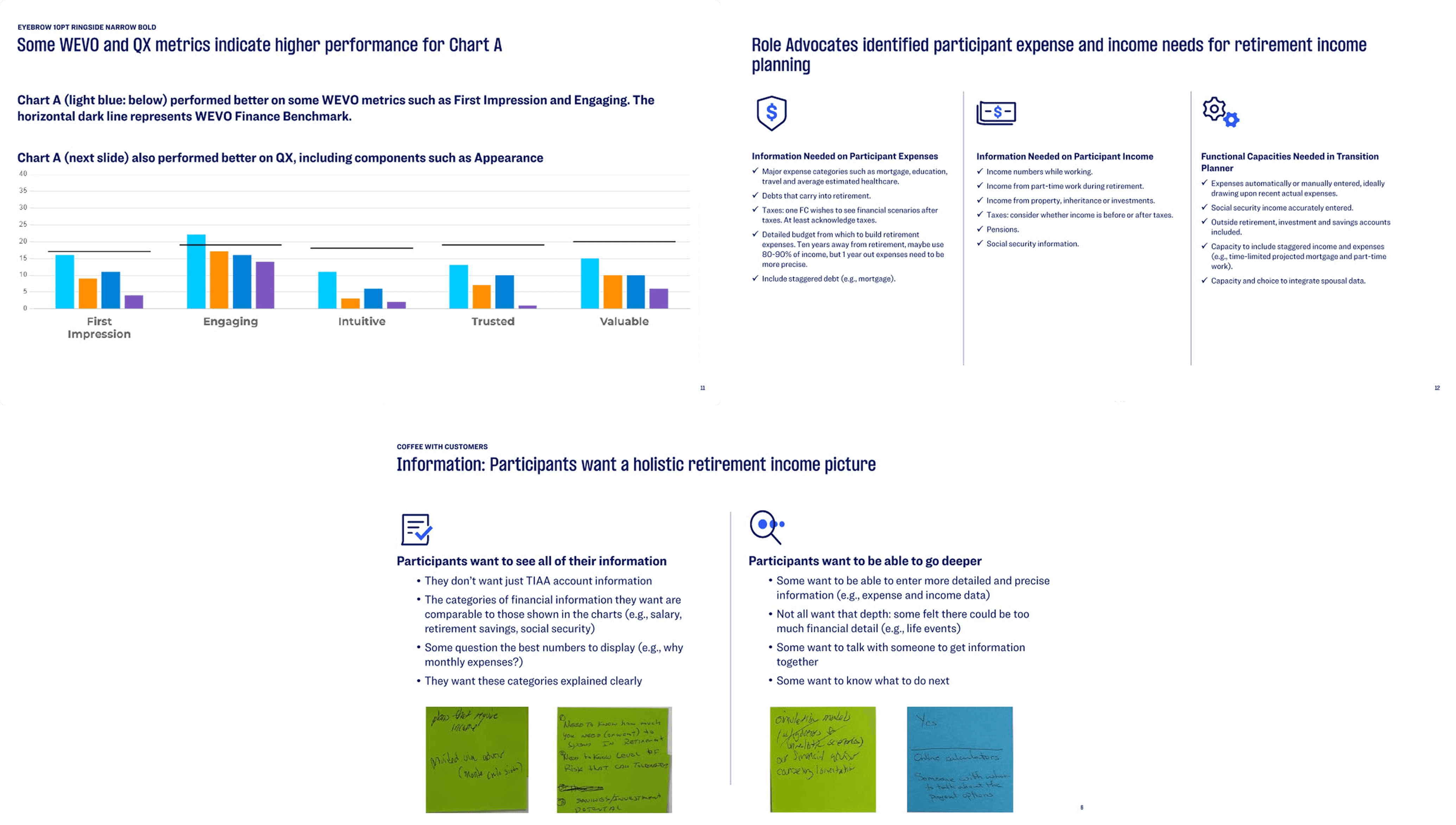
Research finding excerpts.
Research finding excerpts.
Exploration
Exploration
I ran pen-and-paper working sessions to break down the anatomy of a transition planner and align the team on core components, feature sets, and hierarchy before we touched wireframes. We then explored multiple directions. One removed charts entirely in favor of a summary-driven dashboard. Another kept charts but paired them with plain-language explanations. The second tested significantly better with both internal partners and users, and became our foundation.
This was one of the first projects to launch on TIAA's new design system, and the first to introduce data visualization patterns. Working with the design system team, I defined the standards for accessible, scalable data visualization that other teams would reuse, drawing on internal proposals and outside best practices and validating them in a town hall with TIAA users before we finalized.
I ran pen-and-paper working sessions to break down the anatomy of a transition planner and align the team on core components, feature sets, and hierarchy before we touched wireframes. We then explored multiple directions. One removed charts entirely in favor of a summary-driven dashboard. Another kept charts but paired them with plain-language explanations. The second tested significantly better with both internal partners and users, and became our foundation.
This was one of the first projects to launch on TIAA's new design system, and the first to introduce data visualization patterns. Working with the design system team, I defined the standards for accessible, scalable data visualization that other teams would reuse, drawing on internal proposals and outside best practices and validating them in a town hall with TIAA users before we finalized.
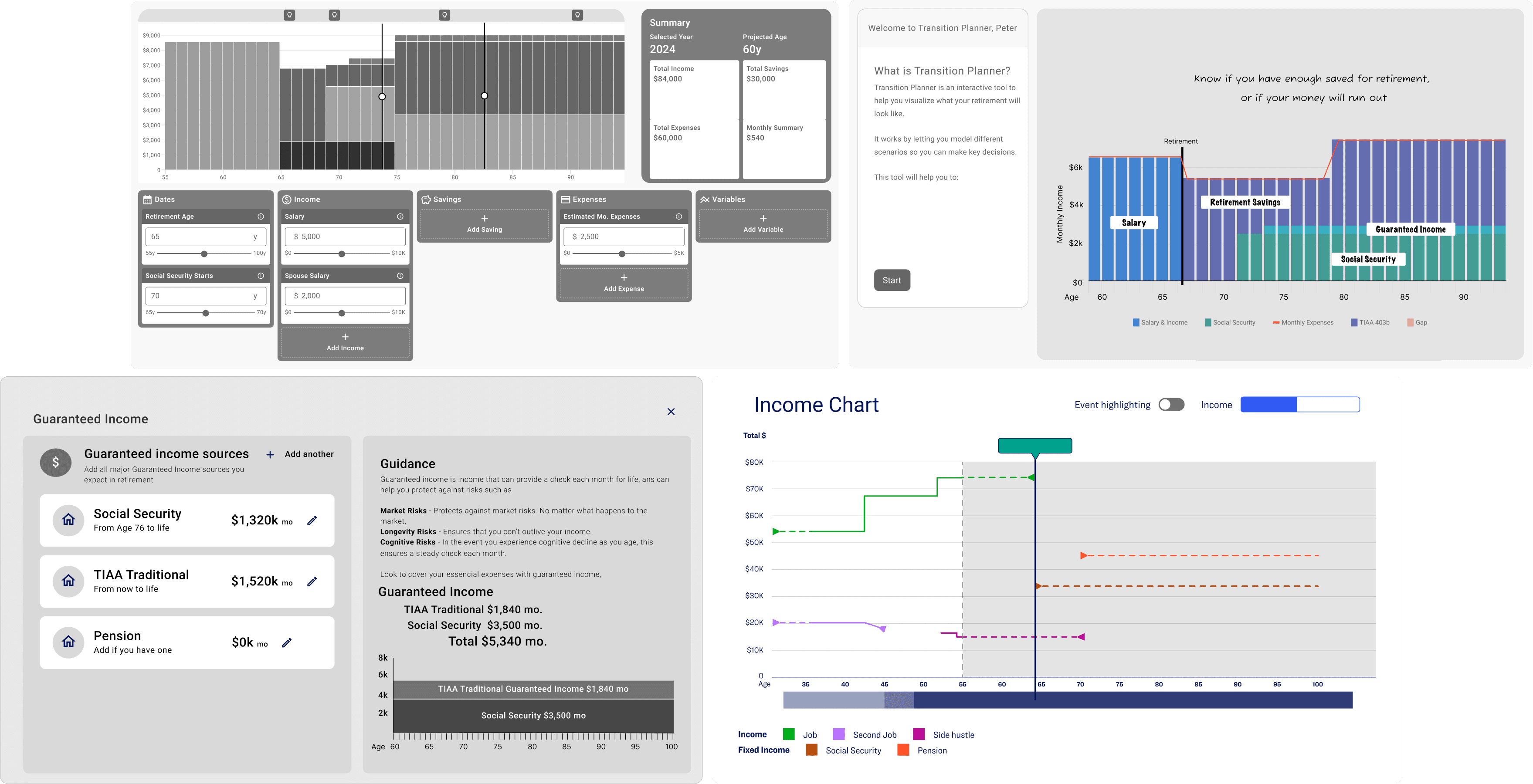
Early low-fidelity wireframe concepts.
Early low-fidelity wireframe concepts.
Making the data readable
Making the data readable
Explaining charts meant defining what information could actually be shown and the best way to show it. I worked closely with content strategy, at times in daily sessions, mapping scenarios and edge cases and plotting the right content for each. (One full content matrix was scrapped and rebuilt.) We also tested a carousel-based insight model, which prompted action well but fell short on comprehension, and considered a GPT-based conversational interface that was scoped out of the MVP for technical and timeline reasons.
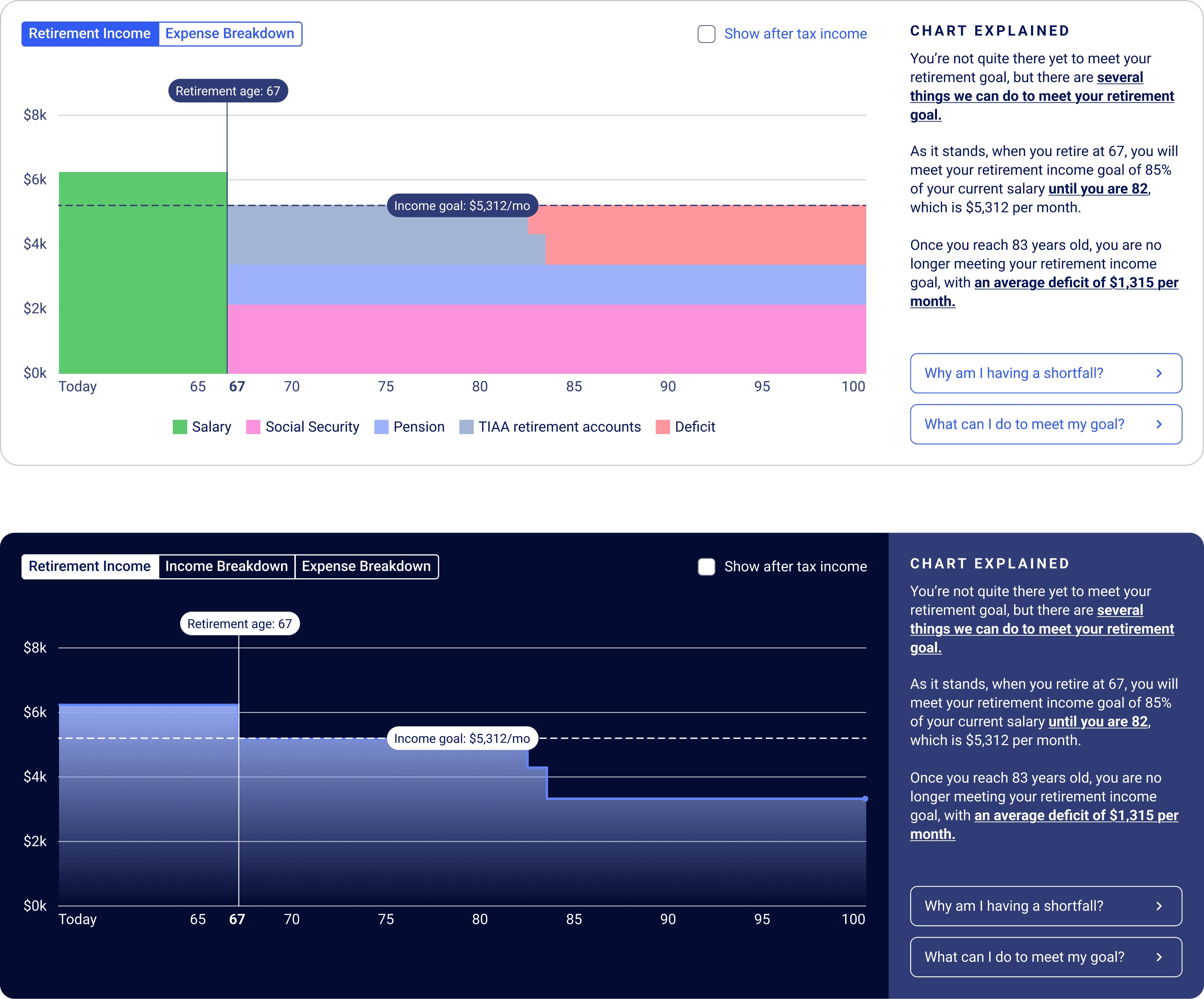
Rejected designs for data visualization variations.
Rejected designs for data visualization variations.
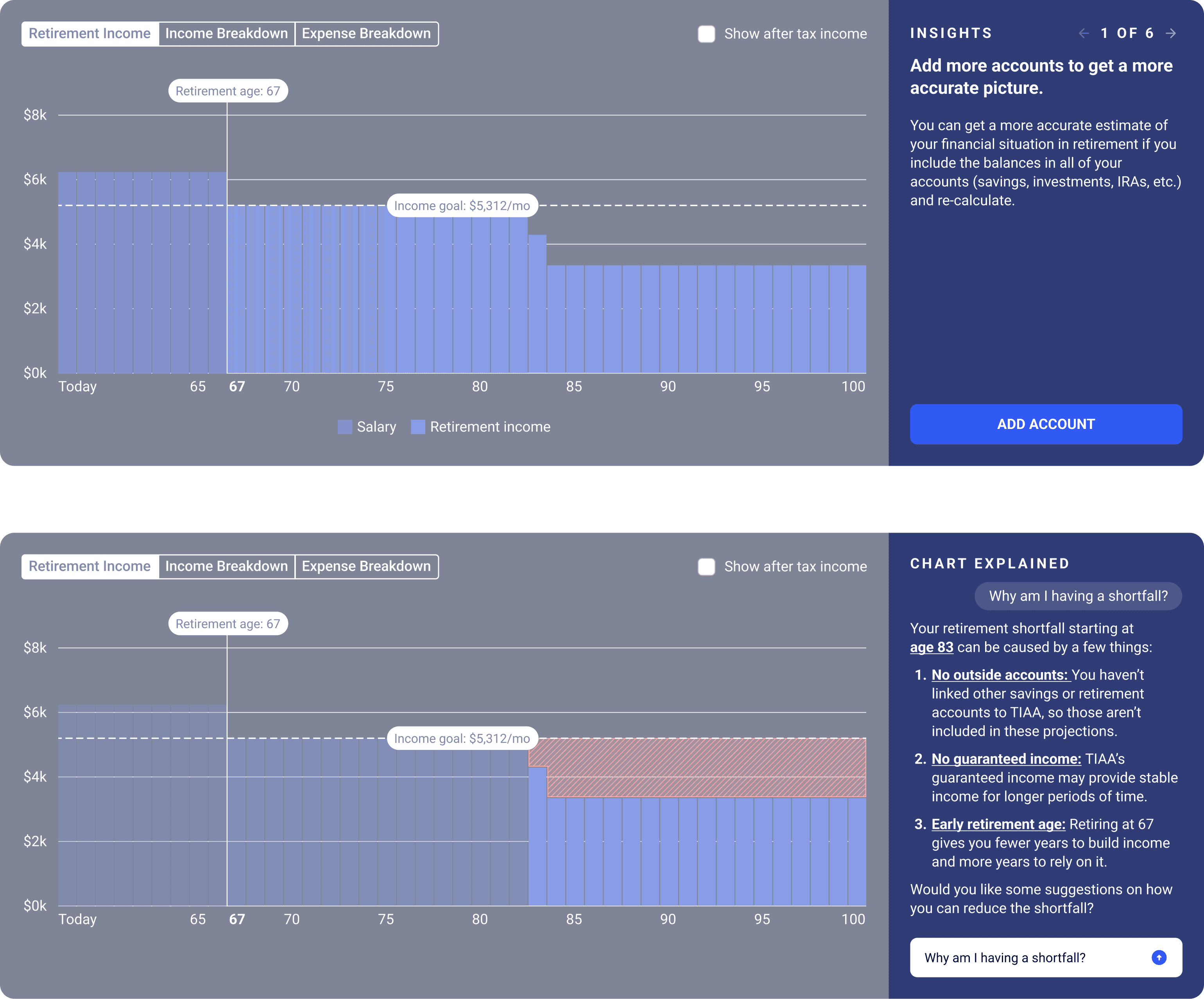
Rejected designs for insights variations.
Rejected designs for insights variations.
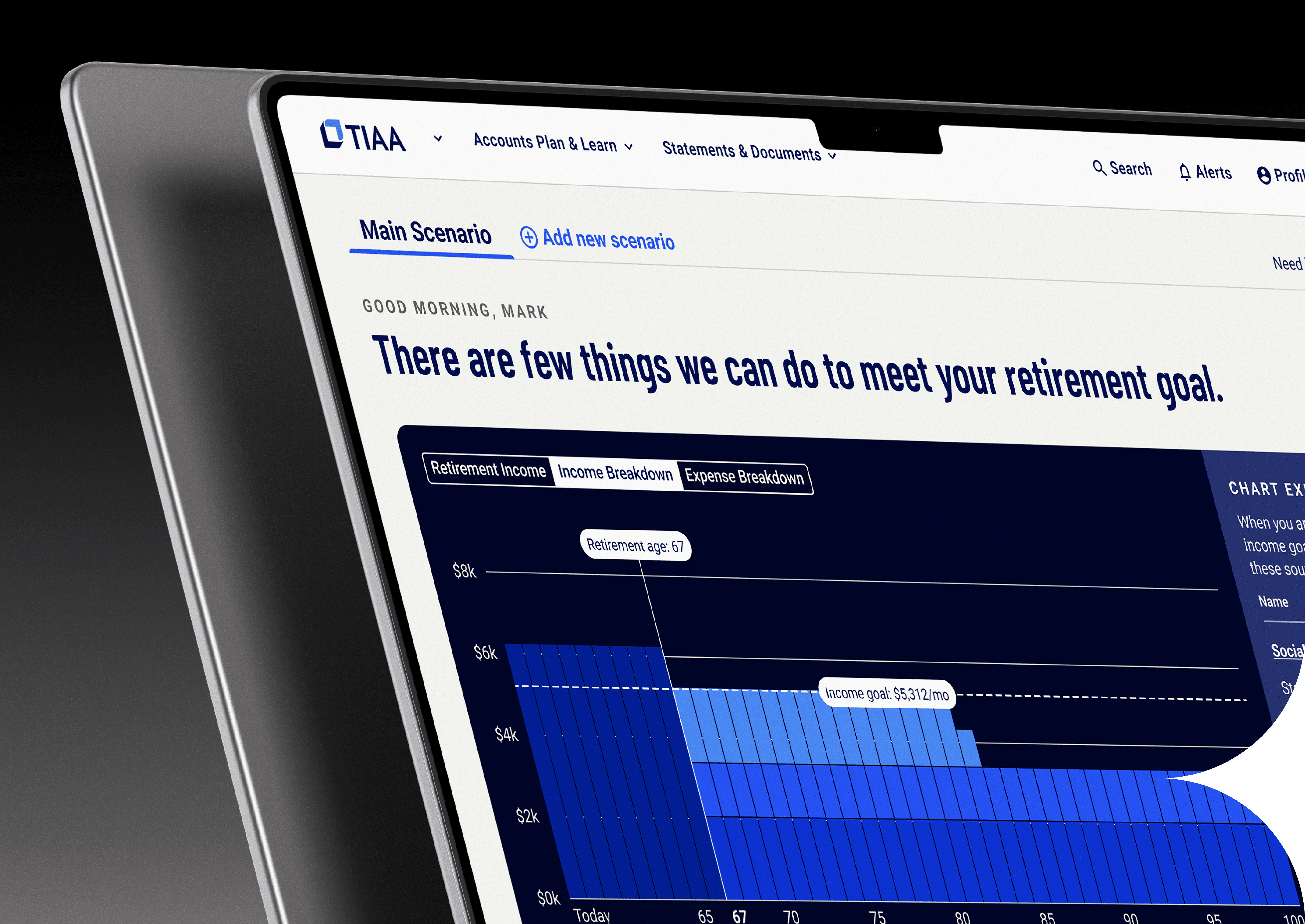
The final experience lowers the barrier to planning by making complex data easier to understand and act on. It establishes a clear visual hierarchy that walks users through their financial story: a high-level summary first, then a detailed breakdown, then suggested next steps.
Landing Page animated.
Landing Page animated.
The final experience lowers the barrier to planning by making complex data easier to understand and act on. It establishes a clear visual hierarchy that walks users through their financial story: a high-level summary first, then a detailed breakdown, then suggested next steps.
Rather than only supplementing charts with text, I focused on making the charts themselves easier to read. The solution uses three charts: the first answers "Do I have enough?" with total income, and the second and third give deeper views into income and expenses, with expense breakdowns available for users who want more control. The charts are interactive, and any interaction updates the accompanying insights so the explanation always matches what the user is looking at.
The final experience lowers the barrier to planning by making complex data easier to understand and act on. It establishes a clear visual hierarchy that walks users through their financial story: a high-level summary first, then a detailed breakdown, then suggested next steps.
Rather than only supplementing charts with text, I focused on making the charts themselves easier to read. The solution uses three charts: the first answers "Do I have enough?" with total income, and the second and third give deeper views into income and expenses, with expense breakdowns available for users who want more control. The charts are interactive, and any interaction updates the accompanying insights so the explanation always matches what the user is looking at.
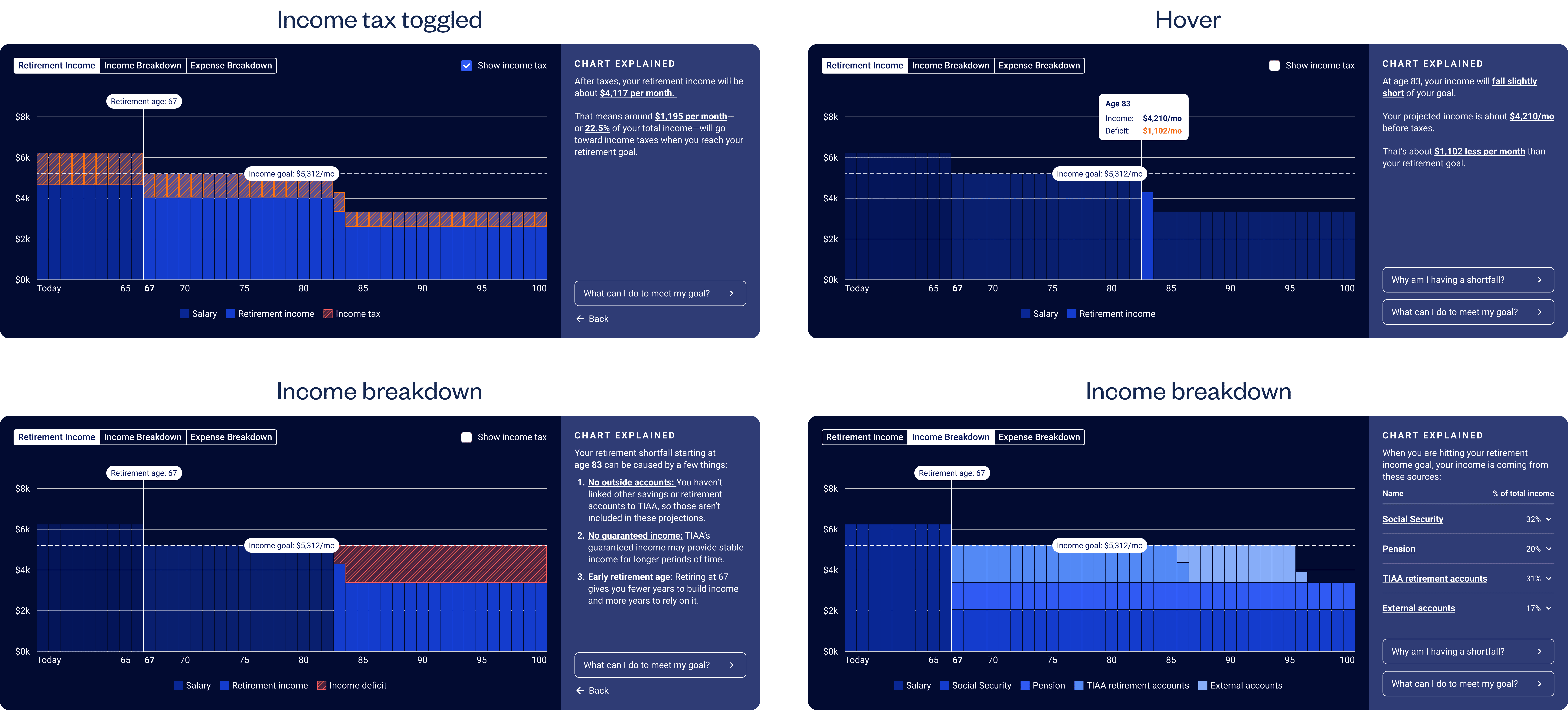
Different chart states and insights.
Different chart states and insights.
Income inputs meant integrating an existing flow from another tool, which I adapted with the owning team. Reworking it into a modal overlay conflicted with the design system's guidelines, so I worked with the design system team to define a new modal pattern for structured data input.
Income inputs meant integrating an existing flow from another tool, which I adapted with the owning team. Reworking it into a modal overlay conflicted with the design system's guidelines, so I worked with the design system team to define a new modal pattern for structured data input.
Income breakdown modal overlays.
Income breakdown modal overlays.
Expense inputs were new. I proposed a bulk-editing experience to reduce friction, which was deferred post-MVP for scope, so for launch we aligned to the updated income input pattern. Based on user feedback, I added support for multiple scenarios so users can compare financial paths without losing progress, and a "Questions to Consider" section that surfaces common questions in context. The original goal was to tie those questions to chart data directly, but technical constraints pushed that to later, so I worked with content strategy to curate resources from TIAA's education library for the MVP.
Expense inputs were new. I proposed a bulk-editing experience to reduce friction, which was deferred post-MVP for scope, so for launch we aligned to the updated income input pattern. Based on user feedback, I added support for multiple scenarios so users can compare financial paths without losing progress, and a "Questions to Consider" section that surfaces common questions in context. The original goal was to tie those questions to chart data directly, but technical constraints pushed that to later, so I worked with content strategy to curate resources from TIAA's education library for the MVP.
Rejected WIP prototype for adding expense flow.
Rejected WIP prototype for adding expense flow.
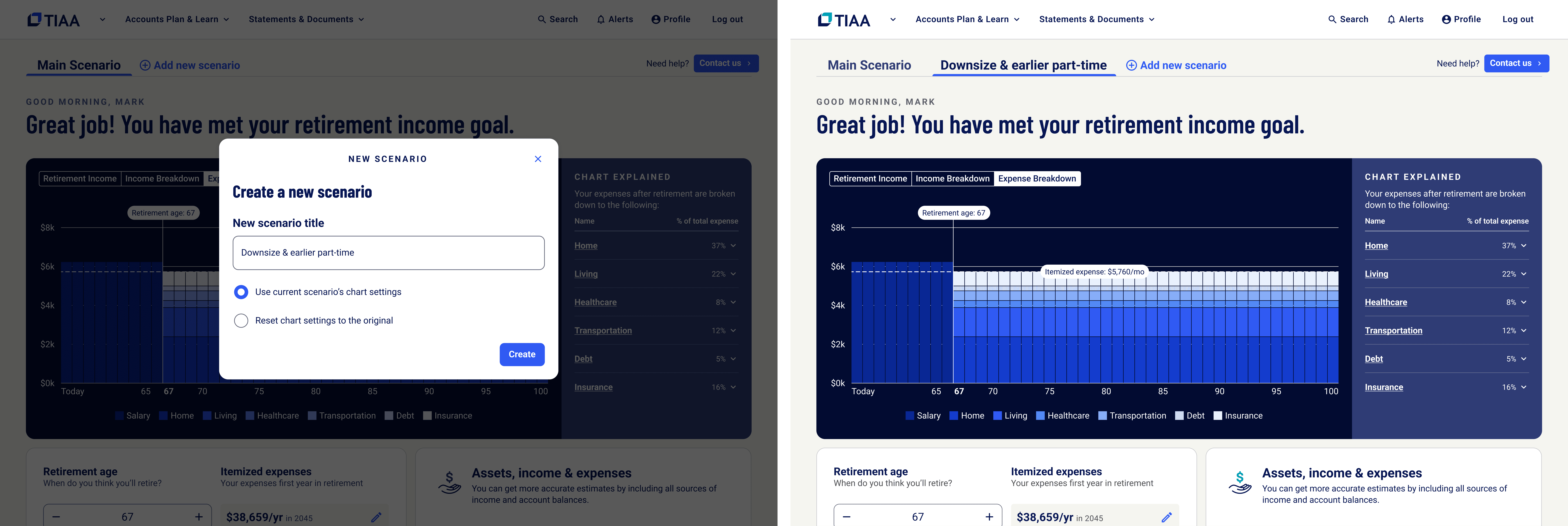
Add new scenario.
Add new scenario.
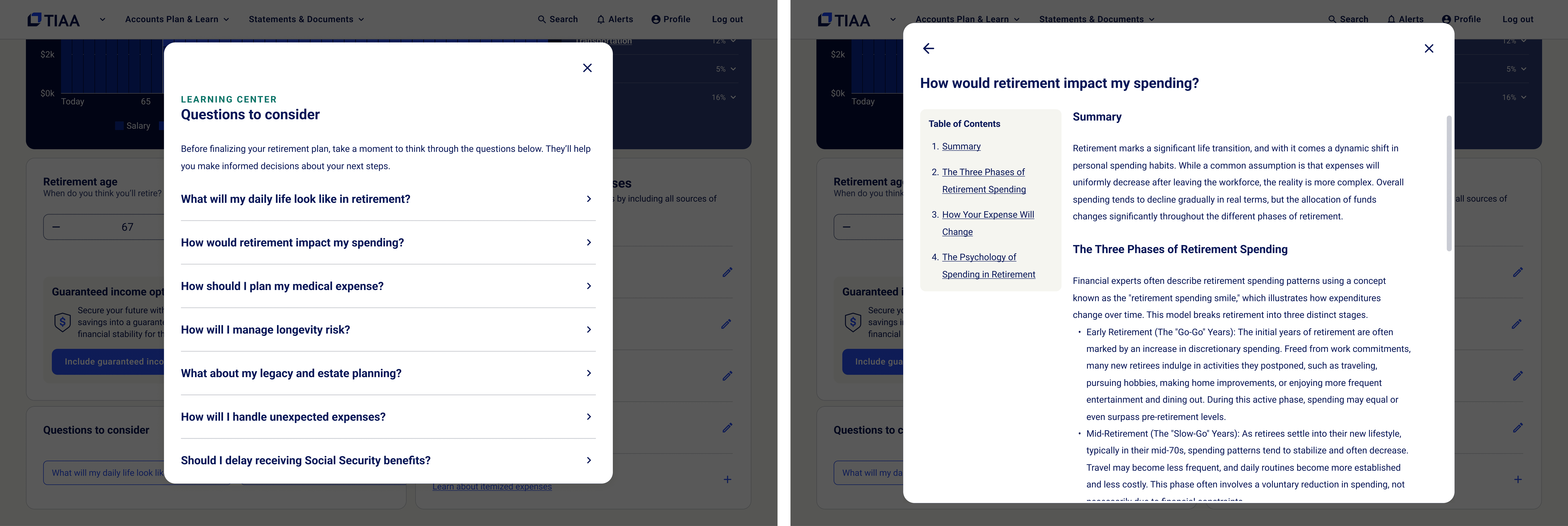
Questions to Consider.
Questions to Consider.
What's next
What's next